
Families hold out on Ras al-Ain, the last hilltop Qusra has left
Settlers pitched a tent metres from three homes on 9 August, the sharpest point in a campaign that has run seven months against a hill holding four springs and most of the farmland the village can still reach.
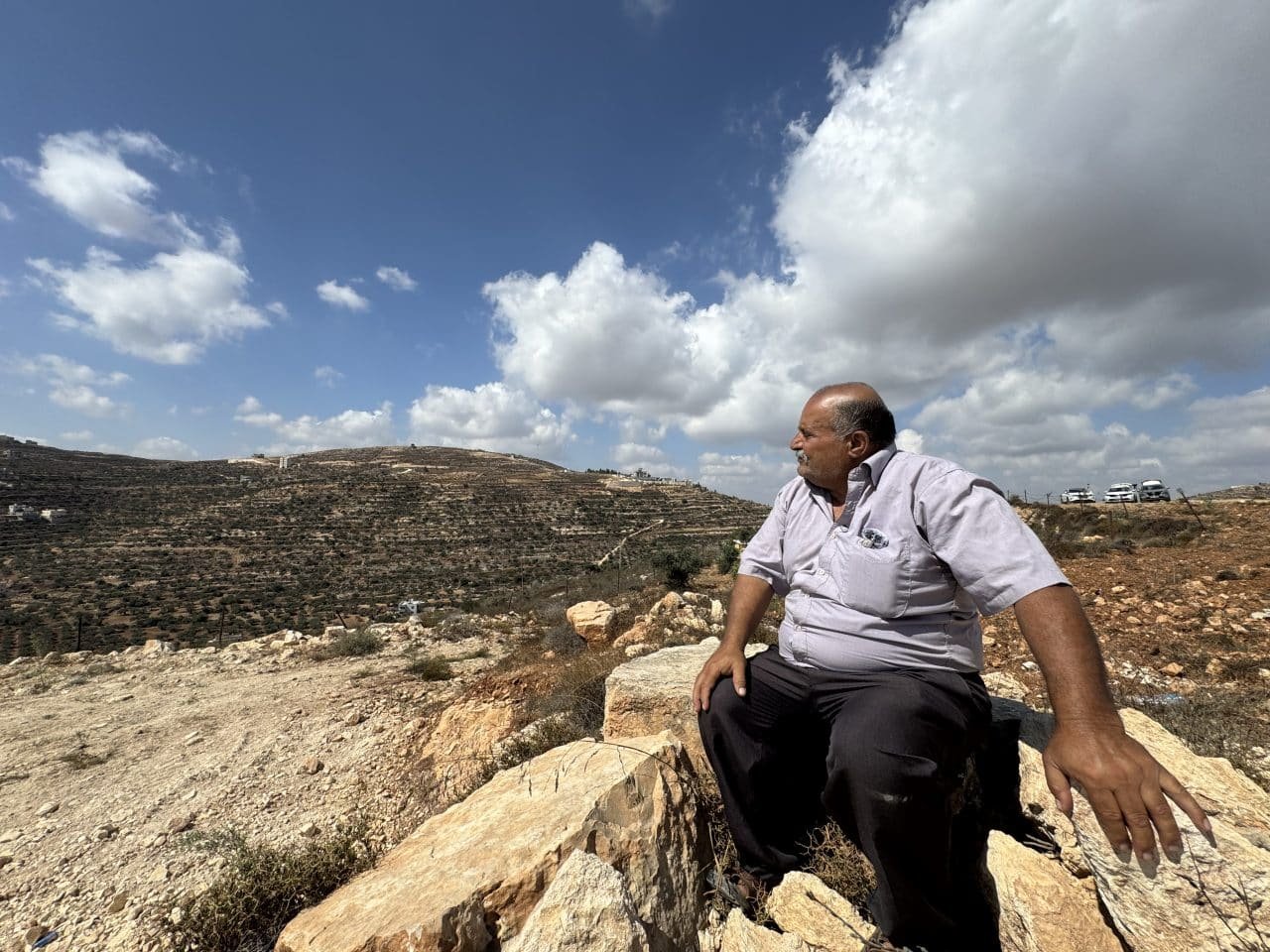
Settlers have been attacking Ras al-Ain, a hill on the edge of Qusra south of Nablus in the occupied West Bank, for seven months — cutting the water and electricity lines that reach it, breaking into houses, and setting ambushes along its road. On 9 August they pitched a tent a few metres from the walls of three Palestinian homes and closed the only way in.
Two of those houses belong to the sons of Abdul Karim Hassan, a farmer of 63. He now sleeps in his car on a hill at Jurish, about 800 metres opposite, where residents and journalists gather through the day to watch the besieged homes. Inside are his wife, 60; his son Rizq, with his wife; and his daughter Aisha, 23. The house of another son, Yousef, was taken over by Israeli forces and turned into a military post; Yousef's wife Ruqaya and their daughters Hur and Kinda, aged 2 and 4, had been living in it.
Reached by telephone inside the cordon, Aisha said the families would not go. "We're all shut in here, like a kind of prison — and we refuse to leave, because they won't let us come back," she said.
The family built the two houses in 2015, each of two floors and 200 square metres, on land classified as Area B — the 22 percent of the West Bank where the Palestinian Authority holds civil powers while Israel keeps security control — believing that made it safe. Around them Abdul Karim planted 15 dunams of olive and almond trees.
He owns 55 dunams across Qusra and the neighbouring village of Jalud, and can no longer reach most of it, including a 20-dunam vineyard. He lost this year's entire grape season, a loss he put at 600,000 shekels. The two homes have been broken into and attacked more than 10 times. During one absence of two hours, he said, settlers got inside, opened a 48-kilogram gas cylinder and left it leaking. Nails and sharp tools have been scattered on the road to disable cars.
The siege has spread past the three inhabited houses to roughly 20 buildings still under construction nearby. Their owners are barred from reaching them, and Israeli flags have been raised over them.
What the hill offers explains the pressure on it. Ras al-Ain stands 930 metres above sea level with a command of the ground in every direction, and it holds four freshwater springs that supply Qusra and villages around it. The water lines were among the first things cut. Qusra covers 9,200 dunams, of which only about 3,300 are still within the village council's reach, and four settlements stand around it — Migdalim, Ahiya, Esh Kodesh and Adei Ad — each of them pushing further onto village land since October 2023.
The head of the village council, Abdul Azim al-Wadi, said Israeli forces have formally evacuated settlers from the hill nine times since December 2025 without the presence ending. "The army would confiscate the tent but leave the settler and his sheep behind for us," he said. Around 40 people have been arrested over confrontations at Ras al-Ain and given heavy fines, which he described as a way of keeping them away from the area.
Qusra was among the first villages to set up popular protection committees, volunteers who face settler raids, and has done so since 2014. Eleven of its residents have been killed in that time, most of them while confronting attacks; the most recent was Amir Mu'tasim Odeh, 28, killed at Ras al-Ain on 14 March 2026. Loay Abu Reida, who owns one of the besieged homes, returned from the United States on 17 August and raised an American flag over his house. The homes were stoned on his second day there.
UNICEF has brought food aid in this month, and the Israeli organisation Peace Now tried to reach the houses on 14 August. Al-Wadi said deliveries and visits that stop a few metres short of the doors are not what is needed, and called for the settlers to be removed.
The families have a recent measure of what losing looks like. In July, after a siege of about four months, settlers drove the family of Mahmoud al-Tubasi out of two homes in Jalud and took the properties. Aisha said that is the outcome the households on Ras al-Ain are staying to avoid.