
Ben-Gvir films women prisoners and boasts of their conditions
Video he published on Sunday shows him telling Palestinian women held at Damon that the shortages they describe are his own policy, and that he is pleased with them.
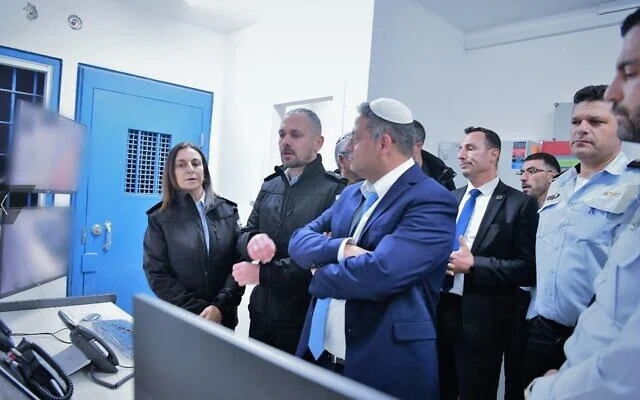
Israel's national security minister, Itamar Ben-Gvir, published video of himself on Sunday walking into a section of an Israeli prison where Palestinian women are held and telling them that the shortages they had just described to him were his own policy. Israeli media identified the prison as Damon, in the north of the country, where most Palestinian women in Israeli custody are held.
In the recording, one of the women tells him that staff raid the section repeatedly, by day and by night, and that she and the others are left without usable water, without clean clothes and without medical treatment. It was their third day, she says, with no chance to wash. Speaking through an interpreter, the minister replied that the era of "good conditions" in the prisons was over, that he was directly responsible for everything in them, and that he was pleased with the result. He turned down her request that the conditions be eased. The women's faces were blurred before the video was released.
In the text he posted with it, he described prisoners' complaints as "whining" from "terrorists", set their treatment against that of Israelis held captive in Gaza, and said he would go on running the prisons at what he called the bare minimum of the minimum.
The Palestinian Prisoners' Society said the filming of the women and the decision to publish the footage were an assault on their dignity, and that a minister who repeatedly releases such recordings is not documenting the prisons but campaigning inside them. It said hundreds of testimonies gathered from prisoners and from people released from Israeli jails and military camps record sustained mistreatment and the withholding of basic rights.
The Commission of Detainees and Ex-Detainees Affairs described the visit as a piece of political theatre rather than an inspection, staged to frighten the women and to break them in front of a camera. Conditions of this kind, it said, are not neglect but a policy of retaliation, built on humiliation, hunger and deprivation.
It was the second such recording this month. Earlier in August the minister filmed himself dismissing another woman prisoner's account of poor food, dirty water, absent medical care and lack of time in the open air, telling her that a prison is not a hotel. Since taking office at the end of 2022 he has cut the food and water supplied to Palestinian prisoners, restricted and cancelled family visits, shortened showers, withdrawn what the prison service classes as privileges, widened the use of isolation and moved hundreds of prisoners between facilities. In 2025 he publicly opposed an Israeli court ruling that ordered the authorities to feed Palestinian prisoners adequately.
What has happened inside Damon in recent weeks is documented separately from the video. Prisoner organisations counted seven raids and punishment operations against the women's sections between 29 July and 18 August, two of them on 1 August and two more on 17 and 18 August. Three of the women are pregnant and have been cut off from both family and Red Cross visits, the organisations say. Women who have been released describe strip searches, threats, sleep deprivation, sections so crowded that detainees sleep on the floor. Palestinian estimates of how many women are held vary between 88 and 94, and the groups have called on the World Health Organization, and on the International Committee of the Red Cross, to step in.
The significance of a filmed visit is not what it reveals. Almost everything in the video was already on the record, gathered from released prisoners and lawyers and set out in reports that Israeli officials have generally answered by denying or ignoring. What changes when a minister brings a camera in and posts the result himself is the status of that record: the conditions stop being an allegation to be rebutted and become a claim to be made, in his own voice, over the objections of the women standing in front of him.