
Prisoners' groups: Gaza detainees' fate hidden for a third year
Israel's prison service lists 1,358 Gazans as "unlawful combatants". The death in custody of the journalist Ehab Diab came to light only after a petition to Israel's Supreme Court.
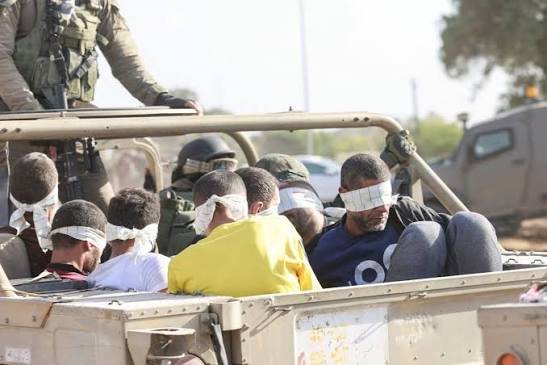
Palestinian prisoners' organisations said on Sunday that Israel has now spent a third year refusing to say who it is holding from the Gaza Strip, where those people are being kept or what state their health is in. Thousands were taken during the war and many of them remain unaccounted for. The joint statement was issued to mark the International Day of the Victims of Enforced Disappearances, which falls on 30 August.
And the organisations said the silence should not be read as a run of separate failures to answer. They described one system, assembled from military orders, from legislation and from the practice of the courts, whose effect is to put a detainee beyond legal protection and to remove the oversight under which torture, ill-treatment and withheld medical care would otherwise be visible.
They set that against the International Convention for the Protection of All Persons from Enforced Disappearance, under which a detention becomes a disappearance once the authorities refuse to acknowledge it or conceal where the person is being kept. The Rome Statute of the International Criminal Court, they noted, makes the same conduct a crime against humanity where it forms part of a widespread or systematic attack on a civilian population.
The framework applied to Gazans is the "unlawful combatant" designation, alongside camps set aside for them and sweeping limits on visits by lawyers and by international monitors. The organisations named Sde Teiman, Anatot, Ofer and Naftali among the facilities in use, and said the prison service had reopened the Rakefet section at Ramleh. They have reached some of the detainees held in them and taken testimony on the conditions inside.
No accurate total exists for how many Gazans have been disappeared. The organisations put that down to the scale of the destruction and the displacement, to the obstruction of search and rescue teams, and to a deliberate refusal to release information.
What has produced answers came from outside that process. Across three years of inquiries the organisations were told in hundreds of cases that the authorities had nothing on the person being asked about, and then photographs of some of those detainees surfaced and showed they had been held all along. Petitions to Israel's Supreme Court have forced acknowledgements that the army was keeping a detainee's body, though never when or how he died.
The case of Ehab Diab, a journalist from Gaza, ran that course. Rights organisations pressing for information about him were told repeatedly that none was available. One of them then petitioned the Supreme Court, and it emerged that the army had his body. On 9 August the prisoners' organisations announced that Diab had died in Israeli custody. The date of his death is still not known.
Figures the Israeli prison service released at the beginning of August put the number of detainees classified as "unlawful combatants" at 1,358. Of the 99 prisoners and detainees whose deaths in Israeli custody since the start of the war the organisations have been able to identify, 53 were people taken from Gaza. Testimonies they have gathered describe torture, ill-treatment and the denial of medical care running from the moment of arrest through interrogation and transfer.
Israel is also holding the bodies of Gazans who died inside its prisons and camps, which the organisations said keeps the circumstances of those deaths out of reach of any independent examination. They asked the United Nations and individual states to move past expressions of concern to binding measures: access for lawyers and for international monitors, independent investigations into the disappearances, the torture and the deaths, prosecutions of those responsible, and the return of the bodies. Concealment on this scale, they said, is "a systematic crime" and not a gap in the records.
Both of the routes that have opened a file so far ran outside the system doing the holding: a photograph that reached the outside world, and a court petition brought by lawyers with no client to instruct them. Neither is available to a family in Gaza. That is why the first demand in the statement is not for a figure but for a channel. A count can be revised later. An answer has to come from whoever is holding the person, and nothing in the arrangement the organisations describe obliges anyone to give one.