
Gaza's wounded ask who decides which patients get to leave
They have gathered outside the Nasser Medical Complex most Sundays for about eight months. Monday's demand was not for speed but for the criteria: tell us how the evacuation list is ordered.
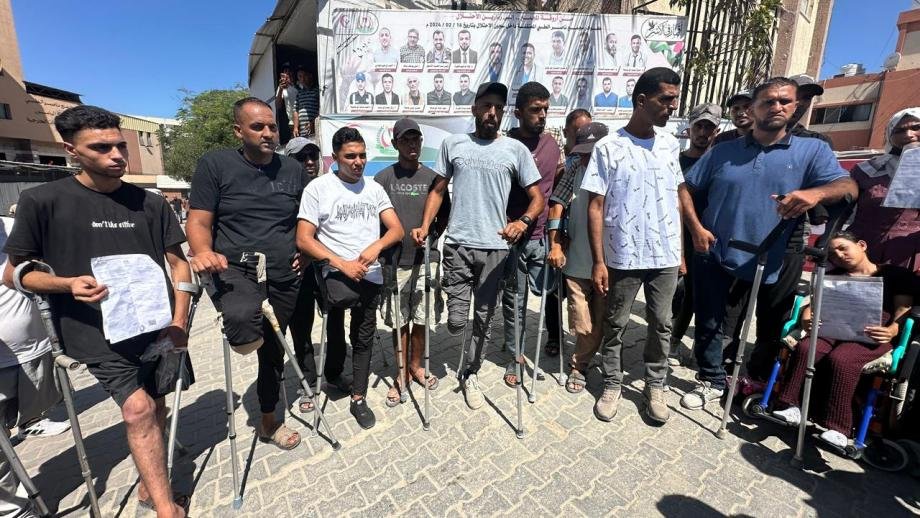
Wounded Palestinians gathered outside the Nasser Medical Complex in Khan Younis, in the southern Gaza Strip, on Monday to press for the crossings to be opened to people who need surgery, rehabilitation or artificial limbs. Much of the territory's health system has been destroyed and that care can no longer be had inside it.
Abdullah Abu Saleha, who was wounded three times over the course of the war, said those taking part were not asking for charity or a favour but for a right, and that the right at issue was access to treatment beyond the Strip. Some of those waiting, he said, need operations and prosthetic limbs that no facility left in Gaza can supply.
He also set out what the waiting costs in surgical terms. An amputee who goes untreated risks complications and worsening disability, and an injury below the knee can deteriorate far enough that the leg has to be taken above it instead. He asked why cases that had reached that point were not being dealt with faster.
The protest is a weekly fixture rather than an event. Abu Saleha said the wounded have assembled every Sunday for roughly eight months without an adequate answer from the authorities involved, and that they leave their families and sit out in the heat, in his phrase, "to make our voices heard".
What he announced on Monday was a condition for stopping. The gatherings will continue, he said, until the bodies running medical evacuation state publicly how the process works and which criteria decide who is permitted to leave. Children and seriously ill patients are among those still on the waiting list.
One of them is Mohammad al-Qahwaji, 38, a photojournalist who does physical therapy daily while his permission to travel is outstanding. He was hit on 7 January 2024, when two strikes landed on the vehicle he was in as he covered the recovery of bodies in northern Rafah. Mustafa Abu Thuraya and Hamza al-Dahdouh, two colleagues of his, died.
His jaw and face were fractured, his spine injured, his right hand badly damaged and one finger lost. More than 25 operations later he still cannot stand or walk for any length of time, and what would change that is not performed where he is.
Mohammad Mataou Dib Abdel Razek, hit by a missile, lost his left leg below the knee and roughly 15 centimetres of bone with it. He has damage to the bone marrow and osteomyelitis in both its acute and its chronic form. He called on the World Health Organization, and on those administering evacuations, to take the most urgent cases first and to let the wounded travel with a companion.
The shift in what is being demanded is the part worth marking. A patient can be told he is on a list without being told how the list is ordered, and that leaves him no way to know whether his file has been passed over or simply not yet reached — and nobody to put the question to. It is why the protest has a fixed day of the week and no end date.