
Volunteers gather the stones of a bombed Deir al-Balah mosque
Marble columns and cut stone from the Abu Salim Mosque, built in 1951 and repaired twice since, are being lifted out and stored so that whatever is rebuilt can be built from the mosque itself.
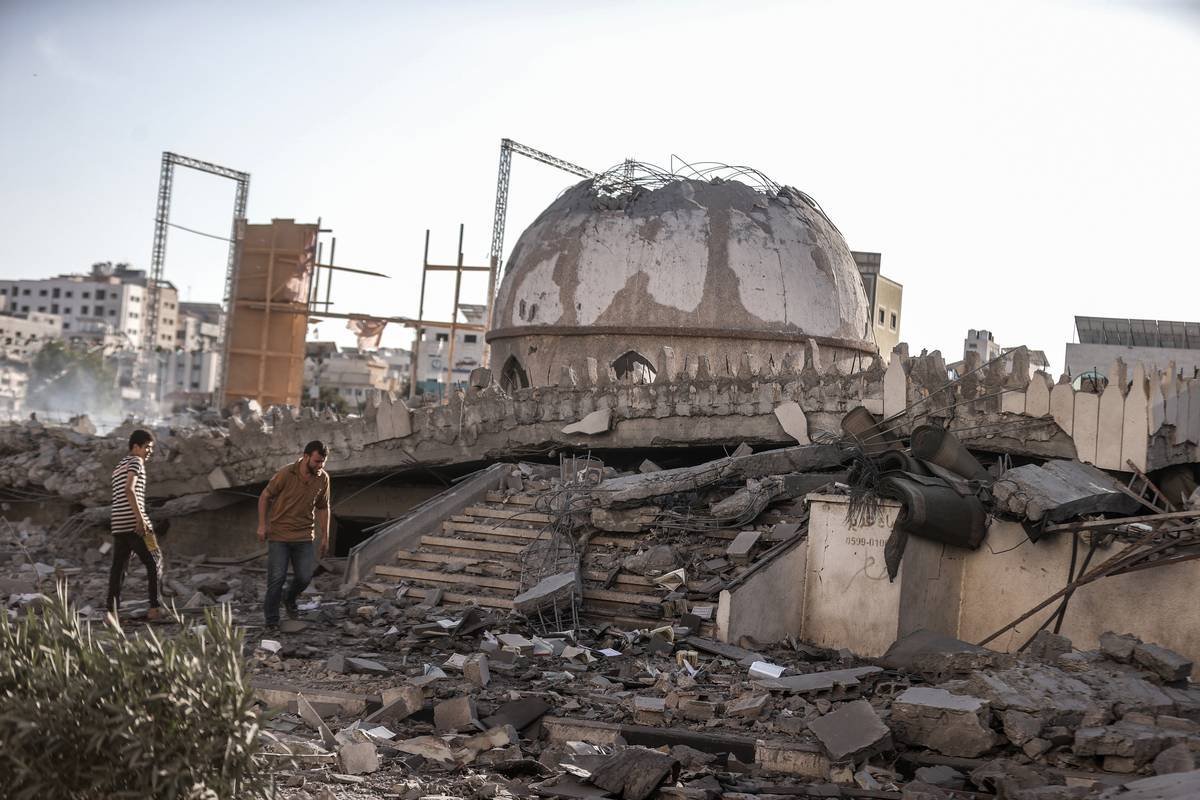
Volunteers in Deir al-Balah have begun recovering stone and marble from the Abu Salim Mosque, a landmark in the centre of the Gaza Strip that an Israeli strike wrecked on 24 August. The work is run by the Mayasir Association for Culture and Arts together with a volunteer team known as the Guardians of Heritage, which cleared debris from the prayer hall's corridors and the courtyards around it before starting to lift out what could still be used.
Shaimaa al-Natour, who coordinates the campaign for the association, said the team reached the site within days of the strike and is carrying out what she called preventive conservation. The first phase is limited to picking scattered stones and the mosque's old marble columns out of the rubble and moving them somewhere safe; restoring the building is left to later stages, for which neither the association nor the municipality has given a date. Damaged books have been carried out of the mosque as well.
The mayor of Deir al-Balah, Khalil Abu Samra, said it dates from 1951, when a benefactor, Hajj Mohammed Abu Salim, paid for its construction, and that its design follows an Ottoman pattern. It stands on high ground the city knows as al-Hadba al-Qibliya. "We preserved this mosque for many years," he said, before expressing hope that the volunteers would return it to what it had been.
This is the second time the building has been hit. Israeli shelling in 2014 took off the upper part of the minaret and damaged the facade, and the repairs that followed were done with the Riwaq Centre for Architectural Conservation and the Iwan Center. A separate restoration in 2010 had kept many of the original architectural features in place. The strike on 24 August did far more: it tore up the courtyard and part of the main structure.
That history is why the sorting matters more than it might appear. A mosque that has been restored twice is a building whose original fabric is still largely its own, and the columns and dressed stone now going into storage are the material a third restoration would have to be made of. Left in the rubble, they would be cleared with it as debris, and what eventually rose on the site would be a new building on an old plot.
The Guardians of Heritage work on archaeological and cultural sites across Gaza and the rest of Palestine, a field of work that has narrowed to salvage as one site after another has been damaged in the war. Their calculation on this hill is a modest one, and it is being made under the same conditions as everything else in the Strip: nobody can say when a restoration will be possible, so the columns are being kept until it is.